
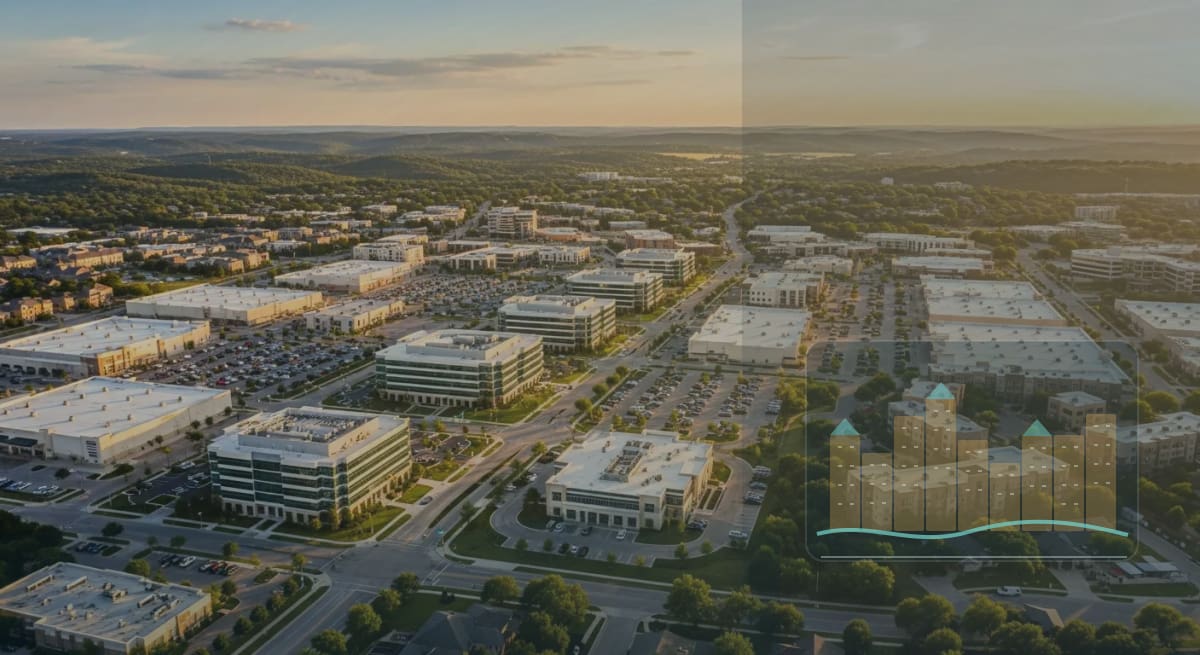
Cedar Park: Northwest Austin's Premium Commercial Hub
Cedar Park has transformed from a quiet bedroom community into a vibrant commercial hub within the northwest Austin corridor. With a population that has grown steadily through both organic expansion and annexation, Cedar Park now supports a sophisticated commercial real estate market spanning retail, office, entertainment, and multifamily sectors. The city's strategic location along US Highway 183 and State Highway 45, combined with its proximity to major Apple and medical device employers in the Williamson County technology corridor, has created a self sustaining commercial market that attracts both local and institutional investors.
What sets Cedar Park apart from other Austin area suburbs is the entertainment and lifestyle dimension. The H E B Center at Cedar Park hosts professional sports (Texas Stars, Austin Spurs) and national touring acts, generating event night traffic that supports surrounding hospitality, restaurant, and retail properties. Combine that with family oriented demographics and household incomes that significantly exceed metro averages, and you get a commercial environment where experiential retail and dining concepts command premium rents alongside traditional service tenants.
Cedar Park's commercial real estate fundamentals benefit from the city's position within one of the most affluent corridors in the Austin metro. Median household incomes significantly exceed state and national averages, supporting premium retail rents and strong consumer spending that attracts national and regional retailers. The city's careful land use planning has preserved commercial corridors for future development while maintaining the residential quality of life that drives continued population growth and commercial demand.
Cedar Park's Commercial Demand Drivers
Tech corridor employment, entertainment infrastructure, healthcare expansion, and affluent demographics support premium commercial rents.
Northwest Austin Technology Corridor
Cedar Park's proximity to Apple's Austin campus, semiconductor manufacturers, and technology firms in the 183 corridor creates a high income employment base that drives demand for premium commercial space and upscale retail services.
H E B Center and Entertainment District
The H E B Center anchors Cedar Park's entertainment economy, hosting Texas Stars hockey, Austin Spurs basketball, and major concerts that generate visitor traffic supporting surrounding hospitality and commercial properties.
Healthcare System Growth
Cedar Park Regional Medical Center and expanding specialty medical practices drive demand for medical office buildings and healthcare related commercial development throughout the city's major corridors.
High Household Income Demographics
Cedar Park's affluent population base supports premium retail rents, specialty dining, and high end service businesses that differentiate the city's commercial tenant mix from more price sensitive suburban markets.
Williamson County Economic Development
Williamson County's pro business environment and economic development incentives attract employers to Cedar Park and surrounding communities, strengthening the broader employment base that supports commercial real estate demand.
Property Types Performing in Cedar Park
Premium retail, medical office, and entertainment adjacent hospitality lead Cedar Park's commercial performance metrics.
Retail Financing
Cedar Park's retail market features a mix of power centers, grocery anchored neighborhood centers, and lifestyle oriented dining and entertainment concepts concentrated along US 183 and Whitestone Boulevard.
Learn MoreOffice Building Financing
Professional and medical office buildings serve Cedar Park's growing base of technology professionals, healthcare providers, and professional services firms operating in the northwest Austin corridor.
Learn MoreMultifamily Financing
Multifamily communities in Cedar Park attract renters seeking the city's quality schools, suburban amenities, and proximity to northwest Austin employment centers, supporting consistent occupancy and rent growth.
Learn MoreHotel Financing
Hotels near the H E B Center and along the US 183 corridor capture business travel and entertainment related demand, with occupancy rates supported by Cedar Park's diversified visitor drivers.
Learn MoreMixed Use Financing
Emerging mixed use developments in Cedar Park blend retail, dining, and residential components to create walkable destinations that appeal to the city's affluent and experience oriented demographic profile.
Learn MoreCapital Requirements in the Cedar Park Market
Why borrowers and investors in Cedar Park seek commercial financing and how CapitalAx structures solutions for each scenario.
Retail Center Refinancing and Acquisition
Investors in Cedar Park's established retail corridors seek competitive permanent financing for grocery anchored and power center assets with strong tenant rosters and above average household income demographics in the trade area.
Entertainment Adjacent Development
Development opportunities near the H E B Center and emerging entertainment districts require construction financing for hotel, restaurant, and mixed use projects designed to capitalize on Cedar Park's event driven visitor traffic.
Medical Office Building Investment
Healthcare expansion in Cedar Park drives demand for specialized medical office financing that accommodates longer lease terms, tenant improvement allowances, and the credit quality of healthcare system tenants.
Multifamily Acquisition and Development
Strong renter demographics and limited new supply in certain Cedar Park submarkets create opportunities for multifamily investment, requiring acquisition financing and construction loans for new apartment development.
Owner Occupied Business Property
Professional services firms, medical practices, and technology businesses seeking to own their Cedar Park facilities need financing solutions that balance occupancy cost advantages with flexible business capital needs.
Financing Cedar Park Commercial Assets
These are the lending programs most frequently matched to deals in the Cedar Park market through our 350+ lender network.
Commercial Mortgage
Long term fixed rate commercial mortgages provide stability for Cedar Park investors holding stabilized retail, office, and multifamily assets in the city's established commercial corridors.
Learn MoreSBA Loans
SBA 504 and 7(a) programs offer favorable terms for owner occupant businesses purchasing or expanding commercial facilities in Cedar Park's high demand corridors.
Learn MoreConstruction Loans
Ground up construction financing supports new retail pad development, medical office buildings, and mixed use projects in Cedar Park's designated growth areas.
Learn MoreBridge Loans
Bridge loans enable Cedar Park investors to execute time sensitive acquisitions and value add renovations, particularly for retail centers and office properties requiring repositioning.
Learn MoreDSCR Loans
Cash flow based DSCR lending streamlines financing for investor owned multifamily and commercial properties in Cedar Park, focusing on property performance rather than borrower income documentation.
Learn Morehotel financing
Hospitality focused lending addresses Cedar Park's hotel market, where entertainment venue proximity and corporate travel demand create unique underwriting considerations.
Learn MoreTools for Cedar Park Investors
Commercial Mortgage and Loan Amortization Calculator
Calculate commercial mortgage payments, total interest, and a month by month loan amortization schedule.
Qualification Checker
Check which commercial loan programs you may qualify for based on your deal profile.
Loan Comparison Tool
Compare multiple loan scenarios side by side to find the best financing structure.
Commercial Refinance Proceeds Calculator
Compare modeled loan limits and subtract payoff and costs to estimate cash out or an equity shortfall.
Northwest Corridor Markets
Explore commercial real estate markets near Cedar Park where CapitalAx arranges financing.
How Affluent Demographics Translate to Better Loan Terms
Cedar Park occupies a distinctive niche within the Austin metro's commercial real estate market as a place where suburban livability intersects with genuine commercial depth. Unlike many outer ring suburbs that remain predominantly residential, Cedar Park has developed the entertainment infrastructure, employment base, and demographic profile that support institutional quality commercial investment. Financing decisions in Cedar Park should reflect this market maturity while acknowledging that the city's continued growth creates both opportunity and competition for capital.
The demographic profile of Cedar Park's resident population directly influences commercial real estate performance and financing terms. High household incomes translate to above average retail sales per square foot, strong restaurant and entertainment spending, and premium rents for well located commercial properties. Lenders evaluating Cedar Park properties benefit from understanding how these demographic advantages create durable cash flow characteristics that may not be apparent from regional market statistics alone.
Cedar Park's relationship with the broader Leander Cedar Park growth corridor is an important consideration for commercial real estate financing. As Leander continues its rapid residential expansion to the northwest, Cedar Park's established commercial infrastructure captures spending from an expanding trade area that extends well beyond city limits. This expanding capture area dynamic strengthens the underwriting case for Cedar Park's commercial properties and supports more favorable financing terms for well positioned assets.