
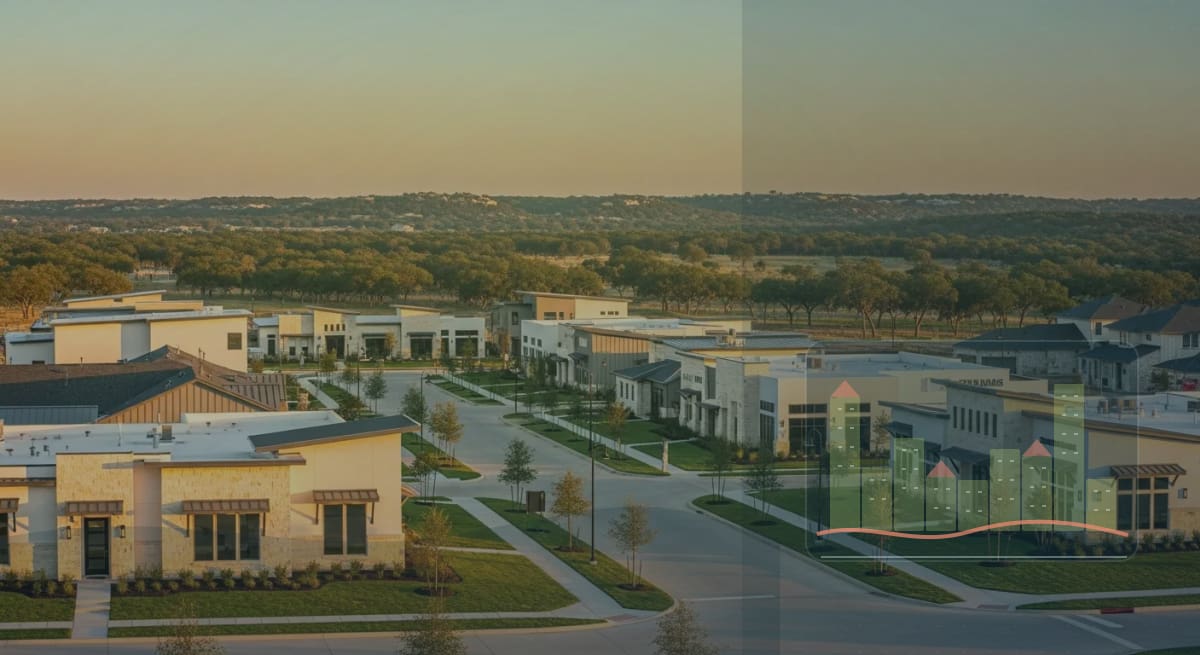
Leander: From Ranch Land to Retail Corridors
Leander has been one of the fastest growing cities in the United States for the past several years, with population growth rates that consistently rank among the top ten nationally for cities its size. What was a quiet Hill Country community 15 years ago is now a city of over 75,000 residents with an expanding commercial infrastructure that includes new retail corridors along US 183 and Ronald Reagan Boulevard, medical office development, and the early stages of an employment center near the Capital Metro rail station. The city's proximity to Cedar Park and the broader Austin metro gives Leander access to a large labor pool while maintaining lower land costs and a business friendly development environment.
Growth stage dynamics define Leander's lending profile. Construction loans fund the new retail centers, multifamily communities, and commercial buildings going up to serve the expanding population. SBA programs help the healthcare practices, franchise operators, and local entrepreneurs establishing operations in a city that still has underserved demand for commercial services. Land development financing turns agricultural parcels along US 183 and Ronald Reagan Boulevard into shovel ready commercial sites. Entry costs here remain below Austin and Cedar Park, but Leander's trajectory gives lenders enough confidence to write construction and development paper.
Leander's long term trajectory is supported by infrastructure investment. The Capital Metro rail extension to Leander provides transit connectivity to downtown Austin. The US 183A toll road connects Leander to the tech employment centers in North Austin and Cedar Park. And the city's comprehensive plan calls for significant commercial development along the Ronald Reagan Boulevard corridor, which will become Leander's primary commercial spine. For investors and developers who understand growth stage markets, Leander offers a combination of lower basis and strong upside potential.
Forces Behind Leander's Commercial Expansion
Population growth, transit investment, and master planned communities are pulling commercial development northwest along the US 183 corridor.
Population Growth
Leander has grown from roughly 26,000 in 2010 to over 75,000 today, making it one of the fastest growing cities in Texas. This growth drives demand for commercial services, healthcare, and retail.
Master Planned Communities
Developments like Travisso, Crystal Falls, and Bryson create neighborhoods with thousands of rooftops that need local retail, dining, medical, and professional services.
Capital Metro Rail
The MetroRail Red Line connects Leander to downtown Austin, creating transit oriented development potential near the Leander station and attracting commuter oriented residents.
Healthcare Development
Baylor Scott & White and Cedar Park Regional Medical Center serve the Leander area, and local medical office development is expanding to meet the needs of the growing population.
Retail Corridor Expansion
US 183 and Ronald Reagan Boulevard are developing into Leander's primary commercial corridors, with new grocery anchored centers, restaurants, and service retail.
What is Getting Built and Financed in Leander
Retail, medical office, and multifamily lead Leander's development pipeline. Here is what investors are financing.
Retail Financing
Grocery anchored centers, restaurant pads, and neighborhood retail along US 183 and Ronald Reagan Boulevard are Leander's most active commercial asset class.
Learn MoreMultifamily Financing
Apartment communities and townhome rentals are delivering to meet housing demand from the city's rapid population growth and proximity to Austin employment.
Learn MoreLand Development Financing
Undeveloped and partially entitled land parcels represent significant investment opportunity in Leander, where commercial development is still catching up to residential growth.
Learn MoreOffice Building Financing
Small format professional and medical office buildings are beginning to develop as Leander's population base supports local healthcare, dental, legal, and financial services.
Learn MoreMixed Use Financing
The area near the Capital Metro station and along Ronald Reagan Boulevard has potential for mixed use development combining residential, retail, and office uses.
Learn MoreWhere Leander Borrowers Need Capital
Why borrowers and investors in Leander seek commercial financing and how CapitalAx structures solutions for each scenario.
Ground Up Development
Leander's growth requires new commercial buildings, retail centers, and multifamily communities. Construction financing is the primary capital need for developers entering this market.
Land Acquisition & Entitlement
Investors acquiring raw or partially entitled land in Leander's growth corridors need land development financing to fund infrastructure and prepare sites for vertical construction.
Small Business Establishment
Local entrepreneurs and franchise operators opening businesses to serve Leander's growing population need SBA and conventional financing for buildout, equipment, and working capital.
Medical Office Development
Healthcare providers building or purchasing medical office space in Leander use SBA 504 and conventional loans to establish practices serving the expanding patient base.
Financing Programs for Leander Projects
These are the lending programs most frequently matched to deals in the Leander market through our 350+ lender network.
Construction Loans
Construction financing is essential in Leander's growth stage market, funding new retail centers, apartment communities, and commercial buildings along the city's expanding corridors.
Learn MoreSBA Loans
SBA 7(a) and 504 programs support the local businesses, medical practices, and franchise operators establishing operations to serve Leander's growing population.
Learn MoreCommercial Mortgage
Permanent financing for stabilized Leander properties, including newer retail centers and multifamily communities with established occupancy.
Learn MoreBridge Loans
Bridge capital for Leander acquisitions where properties need lease up, repositioning, or improvements before qualifying for permanent financing.
Learn MoreEquipment Financing
Equipment financing for Leander businesses in healthcare, food service, fitness, and professional services equipping new locations.
Learn MoreTools for Leander Investors
Commercial Mortgage and Loan Amortization Calculator
Calculate commercial mortgage payments, total interest, and a month by month loan amortization schedule.
Qualification Checker
Check which commercial loan programs you may qualify for based on your deal profile.
Loan Comparison Tool
Compare multiple loan scenarios side by side to find the best financing structure.
Commercial Refinance Proceeds Calculator
Compare modeled loan limits and subtract payoff and costs to estimate cash out or an equity shortfall.
Leander's Neighboring Markets
Explore commercial real estate markets near Leander where CapitalAx arranges financing.
Lending in a Growth Stage Market: What to Expect
Lenders evaluating Leander deals focus heavily on growth projections and population trajectory. The city's historical growth rate provides a strong narrative, but underwriters want to see specific evidence of demand for the proposed project, including rooftop counts, trade area demographics, competitive supply analysis, and evidence of tenant demand. Growth stage markets can be challenging to underwrite because there is limited historical operating data, which makes the quality of the deal presentation critically important.
Construction lenders for Leander projects look for pre leasing or pre sales evidence, experienced development teams, and conservative cost assumptions. The advantage of Leander's lower land costs is partially offset by the need for more extensive infrastructure development in areas that lack existing commercial utilities. Borrowers who can demonstrate a clear path from entitlement through construction through lease up will find receptive lender audiences, particularly among regional Texas banks with Williamson County CRE experience.